
Bohr Model of the Atom Explained
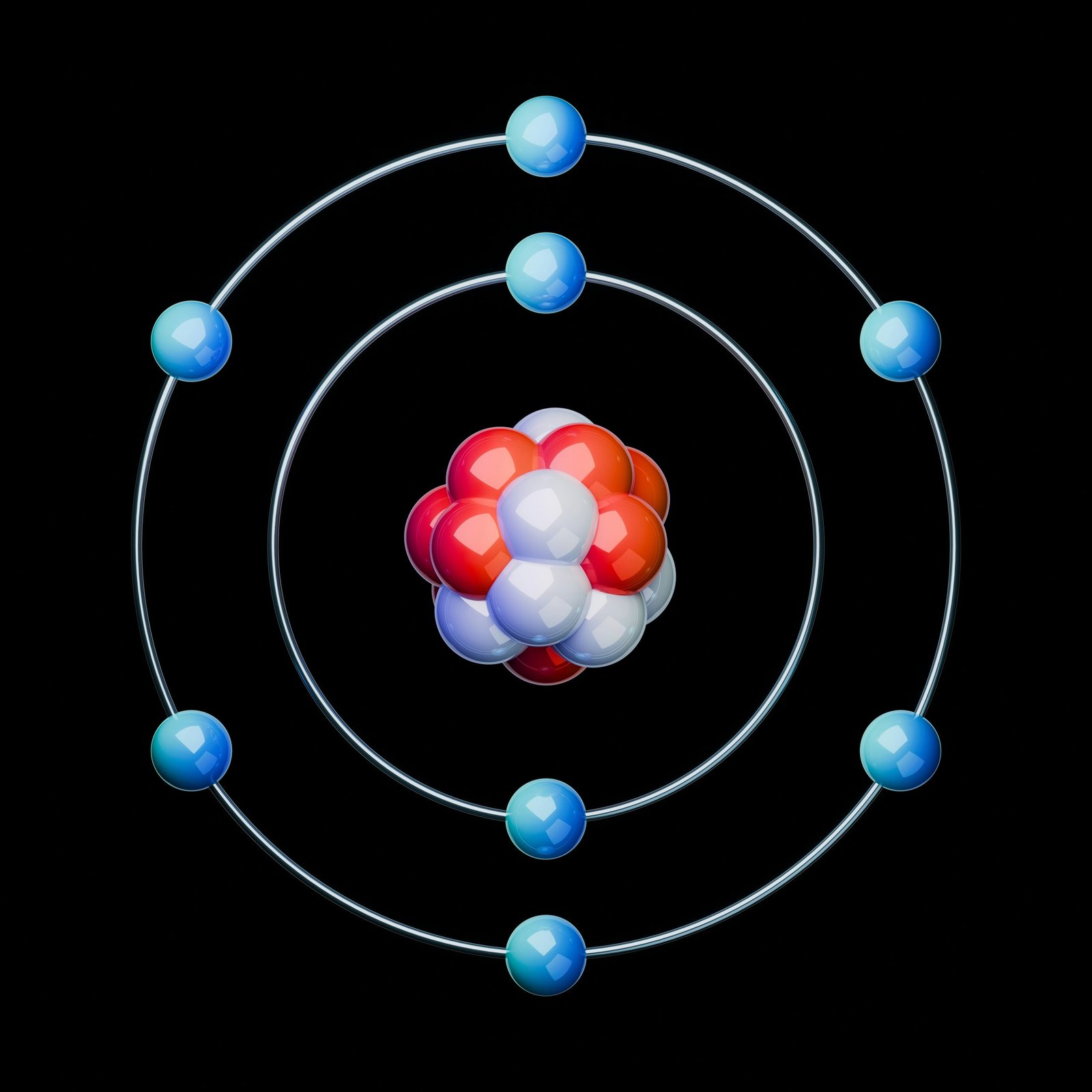
The atom is one of the most important ideas in physics, but understanding its structure was not always easy for scientists. Early atomic models could not fully explain why atoms produce specific colors of light or why electrons do not simply lose energy and fall into the nucleus. These questions led to new ideas that changed our understanding of matter.
In 1913, Danish physicist Niels Bohr introduced a model of the hydrogen atom that combined Rutherford’s nuclear model with the emerging ideas of quantum theory. His model proposed that electrons could occupy only certain allowed energy levels. When an electron moved between these levels, it absorbed or emitted a specific amount of energy.
This idea helped explain the line spectrum of hydrogen and became an important step toward modern quantum mechanics. Although scientists now know that electrons do not move in fixed circular paths in the way Bohr imagined, his model remains useful for learning about atomic energy, electron transitions, and spectral lines.
In this guide, we will explore the Bohr model, its main postulates, important equations, worked examples, and limitations. By the end, you should have a clearer understanding of how the model works and when its formulas can be used.
What Is the Bohr Model of the Atom?
The Bohr model is an early quantum model of atomic structure. It describes an atom as a small, positively charged nucleus surrounded by electrons that can occupy specific allowed energy levels.
In the simplest example, hydrogen has one proton in its nucleus and one electron. Bohr proposed that this electron could occupy certain permitted orbits around the nucleus, but not every possible orbit.
Each allowed orbit corresponds to a particular energy. An electron in a lower energy level has less energy than an electron in a higher level. When the electron changes levels, the atom absorbs or releases energy in a discrete amount.
The model is often drawn as a central nucleus surrounded by circular rings. These rings represent allowed energy levels, not solid tracks that an electron physically follows in the modern quantum-mechanical description.
The main importance of the Bohr model is its explanation of why hydrogen produces a line spectrum instead of a continuous range of colors.
Why Did Bohr Propose His Model?
Before Bohr developed his model, Ernest Rutherford had proposed that an atom contains a tiny, dense, positively charged nucleus. Electrons occupy the region surrounding it. This model explained important experimental observations, but it left a major problem unanswered.
According to classical electromagnetic theory, an accelerating electric charge radiates energy. An electron moving in a circular orbit is accelerating because its direction continually changes. If classical theory were applied directly, the electron would lose energy, spiral toward the nucleus, and make the atom unstable.
Atoms, however, are stable under ordinary conditions. Hydrogen also produces distinct spectral lines when its atoms emit light, which suggested that atomic energy changes occur in specific amounts.
Bohr addressed these problems by proposing that electrons could occupy certain allowed stationary states without continuously radiating energy. Radiation would occur when an electron transitioned between states.
His model was not the final explanation of atomic structure, but it successfully accounted for important features of hydrogen’s spectrum and introduced a powerful idea: atomic energy is quantized.
Bohr’s Main Postulates
Bohr’s model rests on several central assumptions. Together, they describe the permitted electron states and explain how light can be absorbed or emitted by an atom.
Electrons Occupy Allowed Energy Levels
Bohr proposed that electrons can occupy only certain permitted orbits around the nucleus. Each orbit has a specific energy, so an electron cannot have just any energy while occupying one of these states.
These permitted states are commonly labelled by the principal quantum number (n), where:
[
n=1,2,3,4,\ldots
]
The first level, (n=1), is the lowest energy state for hydrogen. Higher values represent higher energy levels.
A useful way to picture this idea is to imagine a staircase. You can stand on one step or another, but you cannot remain halfway between two steps. The analogy is not a literal picture of an electron’s motion; it simply illustrates that the allowed energy values are discrete.
Electrons Do Not Continuously Radiate Energy
In Bohr’s model, an electron in an allowed stationary state does not continuously radiate energy, even though it is described as moving in an orbit.
This assumption addressed the stability problem in the earlier Rutherford model. Without it, the electron would continually lose energy according to classical expectations.
Modern quantum mechanics explains atomic stability differently, using stationary quantum states and the structure of allowed electron wavefunctions. Nevertheless, Bohr’s assumption was an important historical step toward a quantum description of atoms.
Energy Is Absorbed or Emitted During Transitions
An electron can change from one allowed energy level to another by absorbing or emitting energy.
If an electron absorbs the correct amount of energy, it can move from a lower level to a higher one. If it moves from a higher level to a lower one, the atom releases the energy difference, often as a photon.
The photon energy is equal to the magnitude of the difference between the two energy levels:
[
E_{\text{photon}}=|E_f-E_i|
]
Here, (E_i) is the initial energy and (E_f) is the final energy.
Because only certain energy levels are allowed, only particular transition energies are possible. This is why atoms produce characteristic spectral lines.
Angular Momentum Is Quantized
Bohr also proposed that the electron’s orbital angular momentum could take only specific allowed values:
[
L=n\hbar=\frac{nh}{2\pi}
]
In this equation, (L) is orbital angular momentum, (n) is a positive integer, (h) is Planck’s constant, and (\hbar=h/(2\pi)).
This was a major departure from classical physics, where angular momentum could take a continuous range of values.
In modern quantum mechanics, angular momentum is described using quantum numbers and is not generally identical to the simple orbital angular momentum in Bohr’s picture. Still, this quantization rule leads directly to the model’s familiar energy levels and orbital radii.
Bohr Energy Levels
The Bohr model predicts the allowed energies of an electron in a hydrogen atom. For hydrogen, the energy of level (n) is:
[
E_n=-\frac{13.6}{n^2}\text{ eV}
]
The symbol eV means electronvolt, a convenient unit of energy used in atomic physics. One electronvolt is approximately (1.602\times10^{-19}) joules.
The formula shows that energy depends on the square of the principal quantum number. At (n=1), the energy is (-13.6) eV. At (n=2), it is (-3.40) eV, and at (n=3), it is approximately (-1.51) eV.
As (n) increases, the energy becomes less negative and approaches zero. The levels also become closer together at high values of (n).
These energies are measured relative to a free electron and proton separated by an infinite distance, taken as zero potential energy for the bound system.
Energy of the Ground State
The ground state is the lowest-energy state of an atom. For hydrogen, the ground state corresponds to (n=1).
Substituting (n=1) into the Bohr energy formula gives:
[
E_1=-\frac{13.6}{1^2}=-13.6\text{ eV}
]
This is the lowest allowed energy in the model.
The negative value indicates that the electron is bound to the proton. Energy must be supplied to separate the electron completely from the atom, taking the electron from the ground state to the zero-energy reference level.
The ground state is important because atoms generally occupy their lowest available energy state when they have no additional energy to retain in an excited state.
Energy of Higher Levels
When an electron occupies a level with (n>1), the atom is in an excited state. For hydrogen, its energy can be calculated using the same equation:
[
E_n=-\frac{13.6}{n^2}\text{ eV}
]
For example, at (n=2):
[
E_2=-\frac{13.6}{2^2}=-3.40\text{ eV}
]
At (n=3):
[
E_3=-\frac{13.6}{3^2}\approx-1.51\text{ eV}
]
Notice that (-3.40) eV is greater than (-13.6) eV. Although both values are negative, the energy at (n=2) is higher because it is closer to zero.
This detail is important when comparing energy levels. A higher principal quantum number means higher energy and a less tightly bound electron in the Bohr model.
Why Is the Energy Negative?
Negative energy can seem confusing at first, especially when students are used to seeing positive values in ordinary calculations. In the Bohr model, however, the sign has a clear meaning.
The zero of energy is chosen to represent a free electron and proton separated infinitely far apart, with no relative kinetic energy. A bound electron has a lower total energy than this separated state, so its energy is negative.
For ground-state hydrogen, the energy is (-13.6) eV. To remove the electron completely, the atom must gain 13.6 eV.
The negative sign does not mean that the atom has no energy or that the electron has a physically negative amount of mass. It tells us how the bound state’s energy compares with the chosen zero reference.
A useful rule is this: the more negative the energy, the more tightly bound the electron is, within the model. As the electron approaches the ionization limit, its energy moves toward zero.
Ionization Energy of Hydrogen
Ionization energy is the minimum energy required to remove an electron completely from an atom in a specified initial state.
For hydrogen in its ground state, the energy changes from (-13.6) eV to (0) eV. Therefore:
[
\Delta E=0-(-13.6)=13.6\text{ eV}
]
The ground-state ionization energy of hydrogen is 13.6 eV per atom, or approximately (2.18\times10^{-18}) joules per atom.
Ionization energy depends on the starting level. If hydrogen is already in the (n=2) state, its energy is (-3.40) eV, so only 3.40 eV is needed to reach the ionization limit in this idealized calculation.
This is why excited atoms can be ionized with less additional energy than atoms in their ground state.
Worked Example: Finding an Energy Level
Question: Find the energy of an electron in the third energy level of hydrogen.
Step 1: Identify the given value.
The principal quantum number is:
[
n=3
]
Step 2: Write the energy equation.
[
E_n=-\frac{13.6}{n^2}\text{ eV}
]
Step 3: Substitute the value.
[
E_3=-\frac{13.6}{3^2}
]
Since (3^2=9):
[
E_3=-\frac{13.6}{9}
]
Step 4: Calculate the result.
[
E_3\approx-1.51\text{ eV}
]
Answer: The energy of hydrogen’s third Bohr level is approximately (-1.51) eV.
The negative sign shows that the electron remains bound to the nucleus. The result also shows that this state is higher in energy than the ground state.
Electron Transitions
An electron transition occurs when an electron changes from one allowed energy state to another. These transitions explain many of the spectral lines observed in hydrogen.
Suppose an electron moves from (n=1) to (n=3). Its energy increases from (-13.6) eV to approximately (-1.51) eV. The atom must absorb about 12.09 eV to make this transition.
Now consider an electron moving from (n=3) to (n=1). The energy decreases by the same amount, so the atom can release a photon with energy of approximately 12.09 eV.
In general, the energy difference is:
[
\Delta E=E_f-E_i
]
For an upward transition, (\Delta E) is positive and energy must be absorbed. For a downward transition, (\Delta E) is negative, indicating that energy is released. The photon energy itself is a positive quantity equal to the magnitude of this difference.
Worked Example: Electron Transition
Question: Calculate the energy of the photon emitted when a hydrogen electron falls from (n=3) to (n=2).
The initial energy is:
[
E_i=-\frac{13.6}{3^2}\approx-1.51\text{ eV}
]
The final energy is:
[
E_f=-\frac{13.6}{2^2}=-3.40\text{ eV}
]
Calculate the change in electron energy:
[
\Delta E=E_f-E_i
]
[
\Delta E=-3.40-(-1.51)
]
[
\Delta E\approx-1.89\text{ eV}
]
The negative result indicates that the electron loses energy. The emitted photon carries the positive energy difference:
[
E_{\text{photon}}\approx1.89\text{ eV}
]
This transition produces light in the visible red region of hydrogen’s spectrum, known as the H-alpha line. The example shows how a simple energy calculation can connect atomic structure with the colors observed in a laboratory spectrum.
Bohr Model and Hydrogen Spectrum
When hydrogen gas is excited, its atoms can emit light at particular wavelengths. Passing this light through a spectroscope reveals distinct bright lines rather than a continuous rainbow.
Each line corresponds to a photon emitted during a transition between two energy levels. Since the allowed energies are quantized, the energy differences are also restricted to specific values.
The relationship between photon energy and wavelength is:
[
E_{\text{photon}}=\frac{hc}{\lambda}
]
Here, (h) is Planck’s constant, (c) is the speed of light in vacuum, and (\lambda) is the photon’s wavelength.
A larger energy difference corresponds to a higher-energy photon with a shorter wavelength. A smaller energy difference corresponds to a lower-energy photon with a longer wavelength.
Bohr’s calculations successfully explained the main pattern of hydrogen’s spectral lines. This was one of the strongest achievements of his model and helped establish the importance of quantized atomic energy.
Hydrogen Spectral Series
Hydrogen’s spectral lines are grouped into series according to the final energy level of the electron transition. Different series occupy different regions of the electromagnetic spectrum.
Lyman Series
The Lyman series consists of transitions in which an electron falls from a higher level to (n=1).
These transitions release relatively large amounts of energy compared with transitions ending at higher levels. Their wavelengths lie in the ultraviolet region of the spectrum.
Because ultraviolet radiation is invisible to the human eye, the Lyman series is normally studied using suitable scientific instruments rather than by looking for visible colored lines.
Balmer Series
The Balmer series contains transitions from higher levels down to (n=2).
Several of its most familiar lines lie in the visible region. The H-alpha line, which appears red, is produced by a transition from (n=3) to (n=2). Other Balmer lines appear at shorter wavelengths.
The Balmer series is particularly important in introductory physics because it provides a direct connection between electron energy levels and visible light.
Paschen Series
The Paschen series includes transitions ending at (n=3). Its lines lie in the infrared region.
Infrared radiation has longer wavelengths than visible light. Although these lines cannot normally be seen with the unaided eye, they can be measured using appropriate detectors.
The Paschen series illustrates how atomic transitions can produce radiation outside the visible part of the electromagnetic spectrum.
Brackett Series
The Brackett series consists of transitions from higher energy levels to (n=4). Its spectral lines are found in the infrared region.
These transitions involve smaller energy differences than many transitions ending at (n=1) or (n=2). As a result, the emitted photons generally have lower energies and longer wavelengths.
Pfund Series
The Pfund series consists of transitions that end at (n=5). Its lines occur in the infrared region, at generally longer wavelengths than those of the Brackett series.
The names of the hydrogen spectral series provide a convenient way to organize atomic transitions. Remembering the final levels—1 for Lyman, 2 for Balmer, 3 for Paschen, 4 for Brackett, and 5 for Pfund—makes many exam questions easier.
The Rydberg Formula
The Rydberg formula calculates the wavelengths of spectral lines in hydrogen. It relates the initial and final principal quantum numbers to the wavelength of the emitted or absorbed light.
For an emission transition from a higher level (n_i) to a lower level (n_f), the formula is:
[
\frac{1}{\lambda}=R_H\left(\frac{1}{n_f^2}-\frac{1}{n_i^2}\right)
]
Here, (n_i>n_f), (\lambda) is the wavelength in vacuum, and (R_H) is the Rydberg constant for hydrogen, approximately (1.097\times10^7\text{ m}^{-1}).
For example, the transition from (n_i=3) to (n_f=2) belongs to the Balmer series. Substituting the levels gives:
[
\frac{1}{\lambda}=R_H\left(\frac{1}{2^2}-\frac{1}{3^2}\right)
]
[
\frac{1}{\lambda}=R_H\left(\frac14-\frac19\right)
]
The expression in brackets equals (5/36). Evaluating the result gives a wavelength of approximately 656 nm, which corresponds to red visible light.
The Rydberg formula is useful because it lets you calculate a spectral wavelength without separately calculating every intermediate detail of the electron’s orbit. For precise spectroscopy, the isotope, reduced mass, and smaller quantum corrections can also matter.
Bohr Model and Photon Energy
A photon is a quantum of electromagnetic radiation. In the Bohr model, a photon is emitted or absorbed when the atom changes between energy levels.
The photon energy is calculated using:
[
E=hf
]
Since the speed of light in vacuum is (c=f\lambda), the equation can also be written as:
[
E=\frac{hc}{\lambda}
]
Here, (f) is frequency and (\lambda) is wavelength.
These equations show that photon energy increases with frequency and decreases with wavelength. Ultraviolet photons generally have more energy than visible photons, while infrared photons generally have less energy than visible photons.
Be careful to distinguish the energy of the electron from the energy of the photon. During emission, the electron’s energy decreases, but the emitted photon’s energy is positive. The photon carries away the amount of energy the atom loses.
Bohr Radius
The Bohr radius is the characteristic radius of the ground-state orbit in the original Bohr model of hydrogen. Its value is approximately:
[
a_0=5.29\times10^{-11}\text{ m}
]
This is about 0.0529 nanometres.
For hydrogen in the Bohr model, the radius of the (n)th allowed orbit is:
[
r_n=n^2a_0
]
The radius therefore increases with the square of the principal quantum number. The second orbit has a radius four times the Bohr radius, while the third has a radius nine times the Bohr radius.
This relationship helps illustrate why higher-energy states extend farther from the nucleus in the model. However, the Bohr radius should not be interpreted as the exact path of an electron in the modern quantum model. Modern atomic physics describes electron probability distributions rather than fixed circular orbits.
Electron Speed in the Bohr Model
In the original Bohr model of hydrogen, an electron’s speed in the (n)th orbit decreases as the principal quantum number increases.
For hydrogen, the nonrelativistic Bohr speed is approximately:
[
v_n=\frac{\alpha c}{n}
]
Here, (c) is the speed of light and (\alpha) is the fine-structure constant, approximately (1/137).
For the ground state, (n=1), so the speed is approximately:
[
v_1\approx2.19\times10^6\text{ m/s}
]
At (n=2), the predicted speed is half the ground-state value. The model therefore associates higher orbits with larger radii, higher energy, and lower orbital speed.
These speeds are part of Bohr’s simplified orbital picture. In modern quantum mechanics, an electron is not treated as a tiny planet moving along a definite circular path.
Bohr Model of Hydrogen-Like Atoms
The Bohr model can also be applied approximately to hydrogen-like ions. These are species with one electron and a nucleus containing (Z) protons.
Examples include singly ionized helium, He+, and doubly ionized lithium, Li2+. Each has only one electron, although the nuclear charge differs from that of hydrogen.
For a hydrogen-like ion, the nonrelativistic energy levels are:
[
E_n=-\frac{13.6Z^2}{n^2}\text{ eV}
]
The factor (Z^2) means that the electron is more strongly bound as the nuclear charge increases. For the same principal quantum number, a helium ion with (Z=2) has an energy four times as negative as the corresponding hydrogen energy in this approximation.
This formula assumes a point-like nucleus and uses the standard simplified hydrogenic model. Small corrections, including reduced-mass effects and relativistic effects, can be important in precise measurements.
Worked Example: He⁺ Energy Level
Question: Calculate the energy of the electron in the (n=2) level of singly ionized helium, He+.
The values are:
- Nuclear charge number: (Z=2)
- Principal quantum number: (n=2)
Use the hydrogen-like energy equation:
[
E_n=-\frac{13.6Z^2}{n^2}\text{ eV}
]
Substitute the values:
[
E_2=-\frac{13.6(2)^2}{(2)^2}
]
Since both squared terms equal 4:
[
E_2=-13.6\text{ eV}
]
Answer: The energy is (-13.6) eV in this approximation.
This result matches the hydrogen ground-state energy numerically, but the physical situations are different. The He+ electron is in its second energy level, whereas the hydrogen electron is in its first level. This is a useful reminder that energy depends on both the nuclear charge and the principal quantum number.
Absorption and Emission
Absorption and emission describe opposite ways in which an atom exchanges energy with its surroundings.
Absorption
Absorption occurs when an atom takes in energy. If a photon has the correct energy to match an allowed upward transition, the atom can absorb it and move an electron to a higher energy level.
For example, an electron in hydrogen’s ground state can absorb a photon with sufficient energy to reach (n=2). The required energy difference is 10.2 eV.
If the photon does not have the required energy for a particular transition, it generally will not cause that specific bound-to-bound transition. Other processes, including ionization, can occur if the supplied energy is high enough.
Emission
Emission occurs when an atom releases energy, often as a photon, when an electron moves from a higher energy state to a lower one.
The photon’s energy equals the difference between the initial and final atomic energies. Different transitions produce photons with different energies and wavelengths.
This is why excited hydrogen produces several spectral lines rather than one single color. Each allowed transition has its own characteristic energy difference.
Ground State and Excited State
The ground state is the lowest available energy state of an atom. For hydrogen, it is the (n=1) state in the Bohr model.
An excited state is any state with higher energy than the ground state. For hydrogen, the (n=2), (n=3), and higher levels are excited states.
Excited states are often short-lived. An atom may release energy through one or more transitions and eventually return to a lower state. The exact pathways depend on the available states and the relevant quantum-mechanical selection rules.
An excited atom is not necessarily ionized. Ionization occurs when enough energy is supplied to remove the electron from the bound atom entirely. In the energy convention used here, that corresponds to reaching the zero-energy limit.
Energy Level Diagram
An energy level diagram represents the allowed energy states of an atom using horizontal lines. Lower energy levels are placed lower on the page, while higher levels are placed above them.
For hydrogen, the first few energy levels are:
- (n=1): (-13.6) eV
- (n=2): (-3.40) eV
- (n=3): approximately (-1.51) eV
- (n=4): (-0.85) eV
- (n\to\infty): (0) eV, the ionization limit
An upward arrow represents absorption of energy, while a downward arrow represents emission. The energy difference between the starting and ending lines determines the photon energy.
The spacing between the levels becomes smaller as the principal quantum number increases. This is because the energies approach zero according to the inverse-square relationship.
Energy diagrams are particularly useful in examination questions. Label the levels, mark the transition direction, and calculate the energy difference before finding the photon frequency or wavelength.
Why Does the Bohr Model Work for Hydrogen?
Hydrogen is the simplest neutral atom because it contains only one proton and one electron. This makes its structure much easier to model than that of atoms containing several interacting electrons.
The Bohr model successfully predicts the main hydrogen energy levels and explains many of its spectral lines. Its equations also extend to hydrogen-like ions, which contain a single electron around a nucleus with a higher positive charge.
The model’s success comes from its introduction of quantized energy and its treatment of the electron’s interaction with the nucleus. These ideas captured important features of the hydrogen spectrum that classical atomic models could not explain.
However, the Bohr model does not provide a complete description of even hydrogen under every condition. Modern quantum mechanics gives a more accurate account of electron states, spectral details, and atomic interactions.
Limitations of the Bohr Model
The Bohr model was an important development, but it is not the final theory of atomic structure. Understanding its limitations helps explain why quantum mechanics became necessary.
It Does Not Fully Explain Multi-Electron Atoms
The simple Bohr energy formula works well for hydrogen-like systems with one electron. Atoms containing multiple electrons are more complicated because electrons interact with one another as well as with the nucleus.
These interactions change the energy levels and require more advanced quantum-mechanical calculations. The basic hydrogen formula cannot simply be applied to every atom by substituting a different nuclear charge.
Fixed Electron Orbits Are an Oversimplification
Bohr represented electrons as particles moving along definite circular orbits. Modern quantum mechanics does not describe bound electrons as following such exact paths.
Instead, an electron is described by a quantum state, and its position is associated with a probability distribution. These distributions are often represented by orbitals.
The Bohr picture remains useful for building intuition about energy levels, but it should not be confused with the modern description of an atom.
It Does Not Fully Explain Atomic Spectra
The Bohr model explains the main spectral pattern of hydrogen, but it cannot account completely for details such as fine structure, certain intensity patterns, and the effects of external electric and magnetic fields.
More accurate descriptions require quantum mechanics and, for very precise results, additional corrections. These theories account for effects that the simple circular-orbit model leaves out.
It Does Not Explain Chemical Bonding Completely
Chemical bonding depends on how electrons occupy quantum states and interact with other atoms. Fixed circular orbits cannot fully explain molecular structures, orbital overlap, and the range of chemical bonds observed in nature.
Modern quantum mechanics provides the foundation for understanding covalent bonds, molecular orbitals, and many properties of materials.
Bohr Model vs Modern Atomic Model
The Bohr model and the modern quantum model share the idea that atomic energy is quantized, but they describe electrons differently.
In the Bohr model, electrons occupy fixed circular orbits with specific radii and energies. The model provides relatively simple equations for hydrogen and hydrogen-like ions.
In the modern model, electrons occupy quantum states described by wavefunctions. Orbitals show probability distributions rather than definite circular paths. Quantum numbers and the Schrödinger equation help determine the allowed states, while more advanced theories account for additional effects.
The Bohr model is easier to visualize and calculate with in introductory lessons. The modern model is more accurate and can describe multi-electron atoms, chemical bonding, and detailed atomic spectra.
It is best to think of Bohr’s model as an important stepping stone. It introduces quantization and energy transitions without capturing the full complexity of the atom.
Importance of the Bohr Model
The Bohr model holds an important place in the history of physics because it helped connect atomic structure with quantum ideas. It demonstrated that atomic energy could not be described adequately using only classical physics.
Its explanation of hydrogen’s spectral lines provided strong evidence that energy levels are discrete. The model also introduced equations that remain useful in introductory courses, particularly when calculating hydrogen energy levels and photon energies.
Students can use the model to practise algebra, understand ionization energy, analyse spectral transitions, and connect atomic energy with electromagnetic radiation.
Beyond the classroom, the ideas introduced by Bohr helped pave the way for more complete quantum theories. Learning the model provides historical context and a useful starting point for studying modern atomic physics.
Common Mistakes
A few common errors can make otherwise straightforward Bohr-model problems confusing. Checking these details before submitting an answer can improve both accuracy and understanding.
Forgetting the Negative Sign
The energy levels of a bound hydrogen electron are negative relative to the free-electron reference level. Forgetting the negative sign can lead to incorrect energy differences and misunderstandings about ionization.
Always write the full equation first, including the negative sign, and substitute the values carefully.
Using the Wrong Energy Level
When calculating a spectral line, identify both the initial and final levels. The energy of the (n=2) state is not the same as the energy of the (n=3) state, and the transition direction matters.
For emission, the electron moves to a lower energy state. For absorption, it moves to a higher one.
Confusing Photon Energy With Electron Energy
The electron’s energy can decrease during emission, while the emitted photon carries positive energy. The photon’s energy equals the magnitude of the electron’s energy change.
For example, a change of (-1.89) eV in electron energy corresponds to an emitted photon with energy (+1.89) eV.
Assuming Higher n Means More Negative Energy
This is the opposite of what the hydrogen energy equation predicts. As (n) increases, the energy becomes less negative and approaches zero.
The ground state is the most tightly bound state in the model, while highly excited states are closer to the ionization limit.
Applying the Hydrogen Formula to Every Atom
The simple formula (E_n=-13.6/n^2) eV applies to hydrogen in the standard Bohr approximation. For a hydrogen-like ion, the nuclear charge factor (Z^2) must be included.
For atoms with multiple electrons, electron-electron interactions make the situation more complex, so the simple formula is not generally sufficient.
Key Bohr Model Formulas
The following equations summarize the most useful relationships for introductory problems. Always check which atom or ion is being studied and which assumptions apply.
Energy Level
For hydrogen:
[
E_n=-\frac{13.6}{n^2}\text{ eV}
]
Here, (n=1,2,3,\ldots).
Hydrogen-Like Ion
For a one-electron ion with nuclear charge number (Z):
[
E_n=-\frac{13.6Z^2}{n^2}\text{ eV}
]
This is the nonrelativistic hydrogenic result using the standard approximate energy scale.
Photon Energy
The energy of a photon is:
[
E_{\text{photon}}=hf=\frac{hc}{\lambda}
]
Use (h) for Planck’s constant, (f) for frequency, (c) for the speed of light in vacuum, and (\lambda) for wavelength.
Photon Wavelength
For an atomic transition, the wavelength can be calculated from the energy difference:
[
\lambda=\frac{hc}{|E_f-E_i|}
]
Ensure that the units are consistent. If the energy difference is given in electronvolts, convert it to joules before using (h) in joule-seconds and (c) in metres per second, or use a suitable equivalent conversion.
Angular Momentum Quantization
Bohr’s original angular momentum rule is:
[
L=n\hbar=\frac{nh}{2\pi}
]
This is a feature of the historical Bohr model and should not be interpreted as the general angular momentum rule for all modern atomic orbitals.
Bohr Radius
For hydrogen in the Bohr model:
[
r_n=n^2a_0
]
where:
[
a_0\approx5.29\times10^{-11}\text{ m}
]
For hydrogen-like ions, the corresponding nonrelativistic radius is approximately (r_n=n^2a_0/Z), ignoring small reduced-mass corrections.
Rydberg Formula
For hydrogen emission from (n_i) to (n_f), where (n_i>n_f):
[
\frac{1}{\lambda}=R_H\left(\frac{1}{n_f^2}-\frac{1}{n_i^2}\right)
]
The Rydberg constant for hydrogen is approximately (1.097\times10^7\text{ m}^{-1}).
Applications and Uses of the Bohr Model
The Bohr model is primarily an educational and historical model, but the concepts it introduced remain valuable. It helps students understand how quantized energy levels lead to discrete spectral lines and why atoms absorb and emit photons with specific energies.
In spectroscopy, the connection between energy differences and wavelengths helps explain how scientists identify elements by their characteristic spectral patterns. More precise interpretations use modern quantum theory, but the basic idea of transitions between energy states remains central.
The model is also useful for introducing ionization energy, excited states, photon frequency, and the relationship between atomic structure and light. Its simple equations make it possible to solve many introductory problems without advanced mathematics.
In science education, the model provides a bridge between classical ideas and quantum mechanics. It shows why the classical picture of an electron orbiting a nucleus was insufficient and how quantization changed the way scientists understood atoms.
Frequently Asked Questions
What is the Bohr model in simple words?
The Bohr model describes an atom in which electrons can occupy only certain allowed energy levels. When an electron moves between levels, the atom absorbs or emits a specific amount of energy.
Who proposed the Bohr model?
Niels Bohr, a Danish physicist, proposed the model in 1913 to explain important features of atomic structure and hydrogen’s line spectrum.
What is the energy of the ground state of hydrogen?
The ground-state energy of hydrogen is approximately (-13.6) eV in the standard Bohr model. The negative sign indicates that the electron is bound to the proton.
Why are Bohr energy levels negative?
The energy reference is set to zero when the electron and proton are infinitely separated. A bound electron has lower energy than this reference state, so its energy is negative.
What happens when an electron absorbs energy?
If the absorbed energy matches an allowed transition, the electron can move to a higher energy level. If sufficient energy is supplied, the electron can instead be removed from the atom through ionization.
What happens when an electron emits energy?
An electron in an excited state can move to a lower energy state and release the energy difference, often as a photon. The photon’s wavelength depends on the size of that difference.
What is the Bohr radius?
The Bohr radius is approximately (5.29\times10^{-11}) metres. It represents the ground-state orbital radius in the original Bohr model of hydrogen, not a definite electron path in the modern quantum model.
Does the Bohr model work for helium?
The simple hydrogen formula does not accurately describe neutral helium, which has two electrons. However, the Bohr-type hydrogenic formula can be applied approximately to He+, because that ion contains only one electron.
What is the difference between the Bohr model and the modern atomic model?
The Bohr model uses fixed circular orbits, while the modern quantum model describes electrons using quantum states and probability distributions. The modern model provides a more complete explanation of atomic structure and spectra.
Why is the Bohr model still taught?
It introduces quantized energy levels, electron transitions, ionization energy, and atomic spectra through relatively simple equations. These ideas provide a useful foundation for studying quantum mechanics.
Conclusion
The Bohr model of the atom was a major step forward in the development of modern physics. By proposing that electrons occupy allowed energy levels, Niels Bohr helped explain the stability of hydrogen and the discrete lines in its spectrum.
Its central equations make it possible to calculate hydrogen energy levels, ionization energy, electron transitions, and the wavelengths of emitted or absorbed photons. The model also provides a simple introduction to hydrogen-like ions, spectral series, and the relationship between atomic energy and light.
At the same time, it is important to recognize that electrons do not follow fixed circular paths in the modern quantum description. The Bohr model works best as an introductory approximation, especially for hydrogen and one-electron ions.
If you are studying atomic physics, start by learning the energy-level equation, practising transition problems, and connecting each energy difference to a photon. Once those ideas make sense, the Rydberg formula and hydrogen spectrum become much easier to understand.
Post navigation
Use the post navigation section on CheckedPhysics.com to help readers move between related lessons. A previous-post link and a next-post link can make it easier for students to continue studying without returning to the homepage.
Similar Posts
Time Dilation, Length Contraction and E = mc²: Powerful Relativity 2026
Explore how special relativity changes our understanding of time, distance, and the relationship between mass and energy. Learn the basic equations and see when relativistic effects become important.
Heisenberg Uncertainty Principle: 7 Mind-Blowing Facts Explained
Learn why quantum mechanics places fundamental limits on how precisely certain pairs of physical quantities can be known together. Explore the uncertainty principle through clear explanations and examples.
E=mc² — Amazing Mass-Energy Equivalence Explained
Discover how Einstein’s famous equation connects mass and energy. Learn what the equation means, how it is used, and why it is important in nuclear and particle physics.
7+ Powerful Nuclear Binding Energy Formulas & Examples
Understand how nuclear binding energy relates to the stability of atomic nuclei. Work through mass-defect calculations and learn how binding energy per nucleon helps compare different nuclei.
Speed of Light Explained: Powerful Facts, Formula & History 2026
Explore the speed of light, its value in vacuum, and its role in electromagnetism and relativity. Review the main equations and understand why this constant is so important in modern physics.
Half Life Calculations Explained: Powerful Formula & Examples 2026
Learn how radioactive half-life describes the rate of nuclear decay. Practise using the exponential decay equation and understand how much of a radioactive sample remains after a given time.