
SUVAT Equations: 5 Formulas and Examples
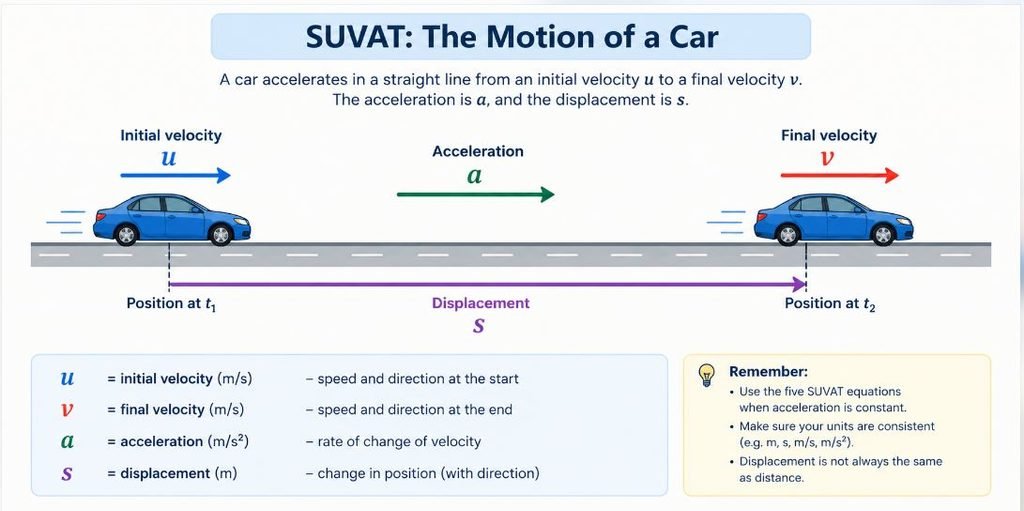
SUVAT equations help you calculate an object’s velocity, acceleration, displacement, and travel time when it moves with constant acceleration. There are five main equations, and the easiest way to choose the correct one is to identify the quantities you know and the quantity you need to find.
Last reviewed: 25 October 2026 | Written by NBK
What are SUVAT Equations?
SUVAT equations are a set of five physics formulas used to describe motion in a straight line when acceleration remains constant. They are part of kinematics, the study of motion without focusing on the forces that cause it.
The name SUVAT comes from the five quantities used in these equations: displacement (s), initial velocity (u), final velocity (v), acceleration (a), and time (t).
For example, imagine a car waiting at a traffic light. When the light turns green, the car speeds up. SUVAT equations can help you calculate its final speed after a certain time or how far it travels while accelerating.
The formula: All 5 SUVAT Equations
Here are the five standard SUVAT equations:
- Final velocity: v = u + at
- Displacement using initial velocity: s = ut + ½at²
- The equation without time: v² = u² + 2as
- Displacement using average velocity: s = ½(u + v)t
- Displacement using final velocity: s = vt − ½at²
Where:
s = displacement (metres, m)
u = initial velocity (metres per second, m/s)
v = final velocity (metres per second, m/s)
a = constant acceleration (metres per second squared, m/s²)
t = elapsed time (seconds, s)
These equations apply to straight-line motion with constant acceleration. They are not generally suitable when acceleration changes significantly during the motion.
Is s distance or displacement?
In SUVAT equations, s stands for displacement, not distance. Displacement is a vector quantity, meaning it considers both how far an object has moved and the direction it moved in. Distance, on the other hand, is a scalar quantity representing the total path travelled.
Because displacement considers direction, an object that returns to its starting point has zero net displacement, even though it has travelled some distance. For example, if you walk 10 metres forward and then 10 metres back, your distance travelled is 20 metres, but your displacement (s) is 0 m.
How it works
The main idea behind SUVAT is that an object’s motion can be described by tracking how its velocity changes over time and how far it moves.
Initial velocity tells you how fast the object is moving at the beginning. Final velocity describes its speed and direction at the end. Acceleration measures how quickly velocity changes, while displacement is the change in position, including direction. Time tells you how long the motion lasts.
Think about a cyclist moving along a straight road. If the cyclist starts at 2 m/s and accelerates at 1.5 m/s² for 4 seconds, the final velocity is:
v = u + at
v = 2 + (1.5 × 4)
v = 8 m/s
The cyclist’s velocity increases from 2 m/s to 8 m/s in four seconds. Notice that acceleration does not mean velocity itself; it describes how quickly velocity changes.
| Variable you don’t have and don’t need | Use this equation |
| If the missing variable is s: use | v = u + at |
| If the missing variable is v: use | s = ut + ½at² |
| If the missing variable is t: use | v² = u² + 2as |
| If the missing variable is a: use | s = ½(u + v)t |
| If the missing variable is u: use | s = vt − ½at² |
For example, if a question gives initial velocity, acceleration and displacement but not time, use v² = u² + 2as. If it gives initial velocity, acceleration and time and asks for final velocity, v = u + at is more direct.
Worked example
Problem: A car starts from rest and accelerates uniformly at 3 m/s² for 5 seconds. Calculate its final velocity and displacement.
Step 1: Identify the known values.
The car starts from rest, so its initial velocity is zero.
u = 0 m/s
a = 3 m/s²
t = 5 s
We need to calculate final velocity (v) and displacement (s).
Step 2: Find the final velocity.
Use: v = u + at
Substitute the values:
v = 0 + (3 × 5)
v = 15 m/s
The car reaches a final velocity of 15 m/s.
Step 3: Calculate the displacement.
Use: s = ut + ½at²
Substitute:
s = (0 × 5) + ½ × 3 × 5²
s = 0 + 1.5 × 25
s = 37.5 m
Answer: The final velocity is 15 m/s, and the displacement is 37.5 m.
Check: The average velocity is (0 + 15)/2 = 7.5 m/s. Multiplying by 5 seconds gives 37.5 m, confirming the displacement. The units are also correct: velocity is measured in m/s and displacement in metres.
Worked example: Braking and negative acceleration
Problem: A car at 20 m/s brakes at 5 m/s² until it comes to rest. Calculate the braking distance and the time it takes to stop.
Step 1: Identify known values.
u = 20 m/s
v = 0 m/s (because it “comes to rest” or stops)
a = −5 m/s² (negative because it is slowing down in the positive direction)
Step 2: Calculate displacement (s) using the equation without time.
v² = u² + 2as
0² = 20² + 2(−5)s
0 = 400 − 10s
10s = 400
s = 40 m
Step 3: Calculate time (t).
v = u + at
0 = 20 + (−5)t
−20 = −5t
t = 4 s
Answer: The braking distance is 40 m and it takes 4 seconds to stop.
Check: Using the average velocity equation: s = ½(u + v)t = ½(20 + 0) × 4 = 40 m ✓.
Practice problems with answers
- A cyclist speeds up uniformly from 4 m/s to 10 m/s in 3 s. Find the acceleration (a) and displacement (s).
- Answer: a = 2 m/s², s = 21 m. (Check: v² = u² + 2as → 100 = 16 + 4(21) ✓)
- A train slows from 30 m/s to 10 m/s over 400 m. Find the acceleration (a) and time (t).
- Answer: a = −1 m/s², t = 20 s. (Check: s = ½(u + v)t → 400 = ½(30 + 10) × 20 ✓)
Common mistakes
- Using the wrong units: Convert values to compatible SI units before calculating. For example, convert kilometres per hour to metres per second by dividing by 3.6.
- Missing the “stops” clue: Phrases like “comes to rest” or “stops” mean final velocity is zero (v = 0).
- Confusing initial and final velocity: The letter u always represents initial velocity, while v represents final velocity.
- Forgetting the direction: If an object slows down while moving in the positive direction, its acceleration is negative. Choose a positive direction and use signs consistently.
- Using SUVAT when acceleration changes: The standard equations assume constant acceleration. If acceleration varies, a different method may be needed.
- Forgetting a square: t² appears in s = ut + ½at² and s = vt − ½at², and the velocities are squared in v² = u² + 2as.
- Assuming displacement always equals distance: Displacement includes direction, while distance is the total path travelled.
SUVAT in university textbooks
As you progress from school to university physics, you will encounter the same SUVAT equations written with slightly different notation. University textbooks often write them as:
- v = v₀ + at
- x = x₀ + v₀t + ½at²
- v² = v₀² + 2a(x − x₀)
Here, v₀ represents initial velocity (instead of u), x represents final position, and x₀ is initial position. Check the exact forms and symbols your textbook uses, because they vary. - Check the exact forms and symbols your textbook uses, because they vary.
Frequently asked questions
1. What does SUVAT stand for?
SUVAT stands for displacement (s), initial velocity (u), final velocity (v), acceleration (a), and time (t).
2. Which SUVAT equation does not contain time?
The equation v² = u² + 2as does not contain time. It is especially useful when a problem gives velocity, acceleration, and displacement.
3. Can SUVAT equations be used for falling objects?
Yes. For an object falling near Earth’s surface, acceleration can usually be treated as constant and approximately 9.81 m/s², provided air resistance is negligible. Choose a positive direction and use the appropriate sign for gravity. Some courses use g = 9.8 m/s² or 10 m/s²; use the value your course specifies.
4. Do SUVAT equations work when an object slows down?
Yes. Slowing down is negative acceleration when the object moves in the chosen positive direction. The equations still work as long as acceleration remains constant.
Summary
SUVAT equations are useful tools for solving straight-line motion problems with constant acceleration. Remember the five variables: displacement, initial velocity, final velocity, acceleration, and time. To choose the right formula, list the known values and select an equation that includes the unknown you need without adding unnecessary unknowns. Always check your units, signs, and final answer to make sure the result makes physical sense.
Sources
- Halliday, David, Robert Resnick, and Jearl Walker. Fundamentals of Physics, 10th edition. Wiley. See the sections on motion along a straight line and constant acceleration.
- OpenStax. University Physics Volume 1. Rice University. Chapter 3, “Motion Along a Straight Line.” Available free at https://openstax.org/details/books/university-physics-volume-1