
Introduction to Electromagnetism: Fields, Currents and Everyday Devices
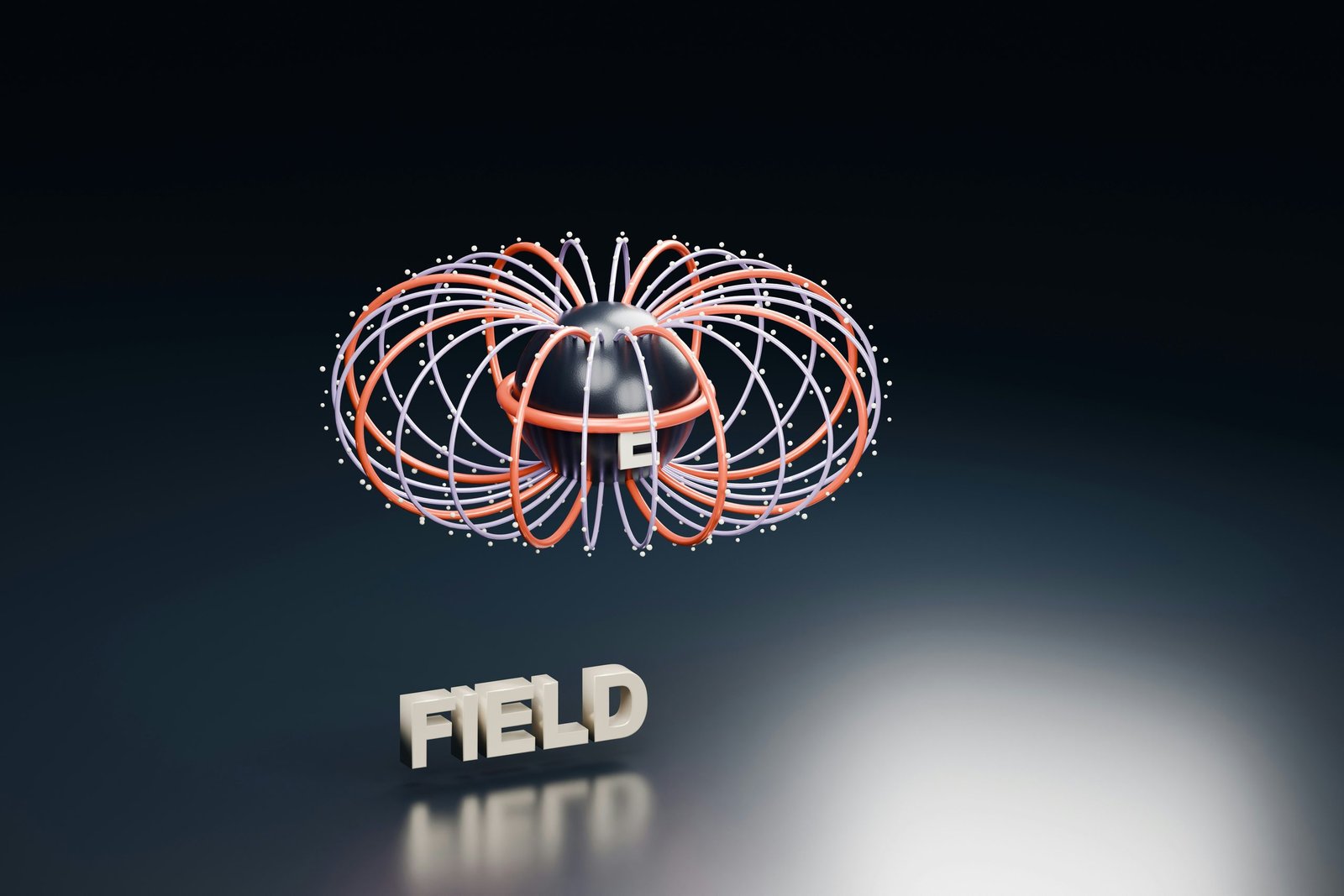
Have you ever wondered how a refrigerator keeps food cold, how a phone receives a wireless signal, or how an electric motor makes a fan spin? These everyday technologies may seem unrelated, but they all depend on one important area of physics: electromagnetism.
Electromagnetism is the branch of physics that studies the relationship between electric charges, electric fields, magnetic fields, and electromagnetic waves. It explains how charged particles interact, how electric currents produce magnetic fields, and how changing magnetic fields can generate electric currents. These ideas form the foundation of much of the technology we use every day.
For college students, electromagnetism can initially feel challenging because it combines abstract ideas with mathematical equations. Electric and magnetic fields cannot always be seen directly, yet their effects are easy to observe. A magnet can attract certain metals, a charged object can attract small pieces of paper, and a current-carrying wire can influence a compass needle.
The key to understanding electromagnetism is to connect these observations with the physical principles behind them. In this article, we will explore what electromagnetism means, how scientists discovered the connection between electricity and magnetism, the basic concepts involved, and how electromagnetic forces explain familiar phenomena in everyday life.
What is electromagnetism?
Electromagnetism describes the relationship between electricity and magnetism. These were once considered separate phenomena, but experiments eventually showed that they are closely connected parts of a single physical interaction.
Electricity involves electric charges and their behavior. Charges can be positive or negative, and their interactions create electric forces. Like charges repel each other, while opposite charges attract. For example, if you rub a plastic comb against dry hair, the comb can become electrically charged and attract small pieces of paper.
Magnetism involves magnetic fields and their effects on moving electric charges, electric currents, and magnetic materials. A common bar magnet has a north pole and a south pole. When two magnets are brought together, like poles repel and unlike poles attract.
The connection between these phenomena becomes especially clear when electric charges move. An electric current flowing through a wire produces a magnetic field around the wire. In the opposite direction, a changing magnetic field can induce an electric current in a conducting circuit. These two effects are central to electromagnetism.
Electromagnetism also explains electromagnetic waves, including radio waves, microwaves, visible light, ultraviolet radiation, X-rays, and gamma rays. Although these waves have different frequencies and wavelengths, they are all forms of electromagnetic radiation.
Visible light is particularly interesting because it connects electromagnetism with something we experience constantly: vision. Light travels through space as an electromagnetic wave and interacts with objects, allowing us to see their color, shape, and position.
At a deeper level, electromagnetism is one of the four fundamental interactions in modern physics. The other three are gravity, the strong nuclear interaction, and the weak nuclear interaction. Electromagnetic interactions are responsible for many everyday forces, including the forces that hold atoms and molecules together.
It is worth noting that electromagnetic forces do not explain every force in nature. Gravity dominates the large-scale motion of planets and stars, while the strong and weak interactions are essential to understanding atomic nuclei and certain particle processes. However, electromagnetism is particularly important for understanding ordinary matter, chemical bonding, electronics, and light.
A useful way to summarize the subject is this: electric charges create electric fields, moving charges produce magnetic effects, and changing electric and magnetic fields are connected in a way that allows electromagnetic waves to travel through space.
The discovery of electromagnetism
The development of electromagnetism took place over several centuries. It was not the result of a single experiment or one scientist’s discovery. Instead, researchers gradually connected observations about static electricity, magnets, electric currents, and light.
People in ancient civilizations knew that certain materials could attract small objects after being rubbed. The Greek word elektron, associated with amber, eventually contributed to the word electricity. Natural magnets were also known in the ancient world, although their properties were not understood in modern scientific terms.
For a long time, electricity and magnetism were investigated as separate subjects. Scientists could observe static electrical attraction and the behavior of magnets, but they did not yet have a complete explanation for how the two were related.
Hans Christian Ørsted and the magnetic effect of electric current
A major breakthrough came in 1820, when Danish physicist Hans Christian Ørsted observed that an electric current could deflect a nearby compass needle. The compass needle responded to the magnetic effect produced by the current.
This experiment provided clear evidence that electricity and magnetism were connected. A wire carrying current could influence a magnetic object even without direct contact.
Ørsted’s discovery encouraged other scientists to investigate the relationship between electric currents and magnetic forces. It also helped establish the foundations of electromagnetism as a unified field of study.
André-Marie Ampère and magnetic interactions
French physicist André-Marie Ampère soon investigated the forces between current-carrying wires. His experiments showed that wires carrying currents could attract or repel one another depending on the directions of the currents.
Ampère helped develop mathematical descriptions of these magnetic interactions. His work became an important foundation for understanding magnetic fields produced by electric currents.
Today, the ampere, the SI unit of electric current, is named in his honor.
Michael Faraday and electromagnetic induction
Another major contribution came from English scientist Michael Faraday. In 1831, Faraday demonstrated electromagnetic induction: a changing magnetic environment can produce an electromotive force, which can drive current in a circuit.
For example, moving a magnet toward or away from a coil of wire can induce a voltage in the coil. If the circuit is closed, that voltage can produce a current.
Faraday’s discovery had enormous practical importance. Electric generators use electromagnetic induction to convert mechanical energy into electrical energy. Transformers also rely on changing magnetic fields to transfer energy between electrical circuits.
Faraday developed an intuitive understanding of electric and magnetic fields, using the idea that fields fill space and influence objects within them. This field-based approach later became central to the mathematical theory of electromagnetism.
James Clerk Maxwell unifies the theory
In the nineteenth century, Scottish physicist James Clerk Maxwell brought together many discoveries about electricity and magnetism into a coherent mathematical framework.
Maxwell’s equations describe how electric and magnetic fields are produced and how they change. His theory also showed that electromagnetic disturbances can travel as waves at a speed determined by electrical and magnetic constants. This speed closely matched the measured speed of light.
That result led to the remarkable conclusion that light is an electromagnetic wave.
Maxwell’s work transformed physics. It connected electricity, magnetism, and optics in one theory and helped establish the foundation for modern communication technologies, electrical engineering, and much of classical physics.
Later experiments by Heinrich Hertz demonstrated the existence of electromagnetic waves beyond the visible spectrum, supporting Maxwell’s prediction. These discoveries eventually contributed to technologies such as radio communication and wireless transmission.
The history of electromagnetism shows how science advances through observation, experimentation, and mathematical reasoning. A small compass deflection led to discoveries that now support power generation, electronic devices, communication networks, and medical imaging.
The basics of electromagnetism
To understand electromagnetism, students should become familiar with a few fundamental ideas: electric charge, electric fields, magnetic fields, electric current, electromagnetic induction, and electromagnetic waves.
Electric charge and electric force
Electric charge is a basic property of matter. There are two types of electric charge: positive and negative. Protons carry positive charge, electrons carry negative charge, and neutrons have no net electric charge.
The interaction between two stationary point charges can be described by Coulomb’s law:
[
F=k\frac{|q_1q_2|}{r^2}
]
Here, (F) is the magnitude of the electric force, (q_1) and (q_2) are the charges, (r) is the distance between them, and (k) is Coulomb’s constant in vacuum.
The equation shows that the force becomes stronger when the magnitudes of the charges increase and weaker as the distance between them increases. Because the force depends on the inverse square of the distance, doubling the separation reduces the force to one-quarter of its original value.
The direction of the force depends on the signs of the charges. Like charges repel, while opposite charges attract.
Electric fields
An electric field describes how an electric charge influences the space around it. Instead of thinking only about a force acting across a distance, physicists use the field to describe the effect that a charge would experience at different positions.
The electric field is defined as the electric force per unit positive test charge:
[
\vec E=\frac{\vec F}{q}
]
The SI unit of electric field is newtons per coulomb (N/C), which is equivalent to volts per meter (V/m).
For a point charge in vacuum, the magnitude of the electric field is:
[
E=k\frac{|Q|}{r^2}
]
where (Q) is the source charge and (r) is the distance from it.
Electric field diagrams often use field lines to represent the direction and relative strength of the field. Lines point away from positive charges and toward negative charges. The lines are a visual tool, not physical threads in space.
Electric fields are important in many technologies, including capacitors, touchscreens, photocopiers, and electrostatic filters.
Electric current
Electric current describes the rate at which electric charge passes through a point in a circuit. It is measured in amperes (A).
The average current is:
[
I=\frac{\Delta Q}{\Delta t}
]
where (\Delta Q) is the amount of charge passing a point during the time interval (\Delta t).
In a metal wire, electrons are the mobile charge carriers. Conventional current is defined as flowing in the direction that positive charge would move, so its direction is opposite to the average drift direction of electrons in a metal.
When current flows through a wire, it produces a magnetic field. This principle makes it possible to build electromagnets, electric motors, relays, and many other devices.
Magnetic fields
A magnetic field describes the magnetic influence around a magnet, current-carrying conductor, or moving charge. The magnetic field is commonly represented by the symbol (\vec B) and is measured in teslas (T).
A simple bar magnet produces a magnetic field around itself. Magnetic field lines form continuous loops. Outside a bar magnet, the lines are conventionally drawn from the north pole toward the south pole.
An electric current also creates a magnetic field. Around a long, straight wire, the field lines form circles centered on the wire. The right-hand rule helps determine the direction: point the thumb of your right hand in the direction of conventional current, and your curled fingers show the direction of the magnetic field.
Magnetic fields can exert forces on moving charges and current-carrying wires. The magnetic part of the force on a moving charge is described by:
[
\vec F_B=q(\vec v\times\vec B)
]
The magnitude is:
[
F_B=|q|vB\sin\theta
]
where (q) is the charge, (v) is its speed, (B) is the magnetic field strength, and (\theta) is the angle between the velocity and magnetic field.
The magnetic force is greatest when the particle moves perpendicular to the magnetic field and zero when it moves parallel or antiparallel to the field. Unlike the electric force, the magnetic force on a point charge is perpendicular to its instantaneous velocity, so by itself it does no work on the particle.
Electromagnets
An electromagnet is a device that produces a magnetic field using electric current. A simple electromagnet can be made by wrapping insulated wire around an iron core and passing current through the wire.
The magnetic field becomes stronger when the current increases or when more turns of wire are added, although the exact behavior depends on the geometry and the magnetic properties of the core. Soft iron is often used because it can become strongly magnetized and lose much of its magnetization when the current is removed.
Electromagnets are used in cranes for lifting scrap metal, electric bells, relays, loudspeakers, and many types of motors. Their key advantage is that the magnetic field can be controlled by changing the current.
Electromagnetic induction
Electromagnetic induction occurs when a changing magnetic flux through a circuit produces an electromotive force. Magnetic flux measures the magnetic field passing through a surface and depends on the field strength, surface area, and orientation.
Faraday’s law can be written as:
[
\mathcal E=-N\frac{d\Phi_B}{dt}
]
Here, (\mathcal E) is the induced electromotive force, (N) is the number of turns in the coil, and (\Phi_B) is the magnetic flux through one turn. The minus sign represents Lenz’s law: the induced effect opposes the change in magnetic flux that produces it.
This principle explains how generators produce electricity. When a coil rotates in a magnetic field, the magnetic flux through the coil changes, creating an induced voltage. In a closed circuit, this voltage can drive current.
Transformers also rely on electromagnetic induction. An alternating current in one coil creates a changing magnetic field, which induces a voltage in another coil. Depending on the turns ratio, a transformer can increase or decrease the voltage in an alternating-current system.
Electromagnetic waves
Electromagnetic waves are disturbances involving changing electric and magnetic fields that travel through space. Unlike sound waves, they do not require air or another material medium.
In a vacuum, electromagnetic waves travel at the speed of light:
[
c=f\lambda
]
where (c) is the speed of light, (f) is frequency, and (\lambda) is wavelength.
Frequency tells us how many wave cycles pass a point each second, while wavelength is the distance between corresponding points on successive cycles. For electromagnetic waves in a vacuum, increasing frequency means decreasing wavelength.
The electromagnetic spectrum includes radio waves, microwaves, infrared radiation, visible light, ultraviolet radiation, X-rays, and gamma rays. They differ in frequency, wavelength, and photon energy, but they share the same fundamental electromagnetic nature.
Radio waves are used for broadcasting and communication. Microwaves are used in communication systems and microwave ovens. Infrared radiation is important in thermal imaging and remote controls. Visible light allows human vision, while X-rays are used in medical imaging. Higher-energy ultraviolet radiation and X-rays can cause biological damage, so exposure must be managed appropriately.
Understanding electromagnetic waves is essential for studying optics, wireless communication, astronomy, and modern medical technology.
Electromagnetism as an explanation for forces and phenomena in everyday life
Electromagnetism may sound like an abstract scientific topic, but its effects are visible throughout daily life. From the moment we switch on a light to the time we charge a phone, electromagnetic principles help explain how modern devices work.
Why magnets attract certain materials
A magnet attracts iron and some other materials because of their magnetic properties. In ferromagnetic materials such as iron, microscopic magnetic moments can form regions called magnetic domains. When these domains align in response to an external magnetic field, the material can become strongly magnetized.
Not all metals are attracted strongly to ordinary magnets. Aluminum and copper, for example, do not behave like iron under typical everyday conditions. Their responses to magnetic fields are different and usually much weaker.
This is a useful reminder that magnetic attraction depends on the properties and internal structure of a material, not simply on whether it is a metal.
How electric motors work
Electric motors convert electrical energy into mechanical motion. In a basic motor, electric current flows through conductors placed in a magnetic field. The magnetic force on these current-carrying conductors produces a turning effect, or torque, that can rotate a shaft.
Electric motors are used in fans, washing machines, water pumps, electric vehicles, and industrial equipment. Their efficiency and controllability make them central to modern engineering.
Although motor designs vary, the underlying idea is the interaction between electric currents and magnetic fields.
How generators produce electricity
Generators work by converting mechanical energy into electrical energy. In many generators, a rotating coil or magnet changes the magnetic flux through a circuit. This change induces an electromotive force according to Faraday’s law.
Power stations use generators driven by turbines. The turbines may be powered by steam, flowing water, wind, or other energy sources. The generator then converts the turbine’s mechanical rotation into electrical energy.
This process shows how electromagnetism connects different forms of energy. The energy delivered by a generator ultimately comes from the mechanical input, not from the magnetic field creating energy from nothing.
How transformers support power distribution
Electricity must often travel long distances from power stations to homes and businesses. Transformers allow the voltage of alternating-current electricity to be increased for transmission and reduced for safe use in many distribution systems.
For an ideal transformer, the voltage ratio is related to the turns ratio:
[
\frac{V_s}{V_p}=\frac{N_s}{N_p}
]
where (V_s) and (V_p) are the secondary and primary voltages, and (N_s) and (N_p) are the corresponding numbers of coil turns.
Real transformers have energy losses, including resistive heating in their windings and losses in the magnetic core. Good design helps reduce these losses.
How speakers and headphones produce sound
Loudspeakers use electromagnetic forces to convert electrical signals into mechanical vibration. A changing current in a voice coil interacts with a magnetic field, causing the coil and attached diaphragm to move. The diaphragm creates pressure variations in the surrounding air, which we hear as sound.
Headphones use related principles on a smaller scale. Other speaker technologies also exist, but electromagnetic designs are common because they can reproduce a wide range of sound frequencies.
How wireless communication works
Mobile phones, Wi-Fi routers, radio transmitters, and satellite communication systems use electromagnetic waves to carry information. A transmitter converts an electrical signal into a suitable electromagnetic signal, which travels through space and can be detected by a receiver.
The receiver then processes the signal to recover information such as speech, video, or digital data. The details depend on the communication system, frequency band, modulation method, antenna design, and signal-processing technology.
Electromagnetic waves make communication possible without a direct wire connecting every transmitter and receiver. However, signals can be weakened or disrupted by distance, obstacles, interference, and environmental conditions.
How light allows us to see
Light is electromagnetic radiation within the visible portion of the spectrum. When light from a source reflects from an object and enters our eyes, the visual system processes the incoming signal and allows us to recognize shapes, colors, and movement.
Mirrors work mainly through reflection, while lenses change the direction of light through refraction. These principles are used in eyeglasses, cameras, microscopes, telescopes, and many optical instruments.
The connection between electromagnetism and light was one of the major achievements of classical physics. It showed that electricity, magnetism, and optics could be understood within a single framework.
Why static electricity makes objects stick
Have you ever taken clothes out of a dryer and noticed that they cling together? This can happen because rubbing and separating materials can transfer electric charge. The resulting charge distribution creates electric forces between the objects.
A charged balloon may also stick to a wall because it causes charges within the wall’s material to redistribute slightly. This process, called polarization, can produce an attractive force even if the wall has no overall electric charge.
Static electricity is usually harmless in everyday situations, but it can create problems around sensitive electronic components or flammable materials. Appropriate grounding and handling procedures help control unwanted charge buildup in technical environments.
Electromagnetism in medical technology
Medical technology makes extensive use of electromagnetic principles. X-ray imaging uses high-energy electromagnetic radiation to create images of structures inside the body. Magnetic resonance imaging, or MRI, uses strong magnetic fields and radio-frequency signals to obtain detailed information about internal tissues.
These technologies work in different ways and have different safety requirements. X-rays use ionizing radiation, while MRI does not use ionizing radiation but requires precautions related to its strong magnetic field and radio-frequency energy.
Electromagnetism also supports electrocardiography, which measures electrical signals associated with heart activity, and many other diagnostic and monitoring devices.
Why understanding electromagnetism matters
Electromagnetism is a foundation for electrical engineering, electronics, communications, robotics, renewable energy, and many areas of physics. Learning its principles helps students understand not only how devices work but also why they are designed in particular ways.
When studying the subject, try to connect each concept to an observation. Ask what creates the electric field, how the magnetic field changes, what causes the force, and where the energy comes from. These questions encourage deeper understanding than memorizing equations alone.